Patient experience in 2026 is no longer defined only by “good consultation.” In real-world OPDs, patients judge quality from the moment they enter a clinic or hospital waiting area: how organized the queue feels, whether waiting time is predictable, whether instructions are clear, and whether they understand the “why” behind tests, medicines, and follow-ups.
This is where a clinic engagement platform becomes a practical game-changer. Not a fancy add-on. A platform that organizes patient flow, delivers education in simple language, enables quick screening prompts, and keeps the waiting area calmer and more informative—without adding workload to the doctor.
For pharma brand managers, this shift is equally important. Traditional visibility tools are losing impact in a world of short attention spans, compliance sensitivity, and measurable ROI expectations. In 2026, smart in-clinic engagement is becoming one of the strongest pharma recall solutions—because it happens where health decisions are made: the point of care.
In this blog, we’ll explore how a patient engagement system for clinics is reshaping care delivery, how to implement it without disrupting workflow, and why SynQOL Health Screen from Indigital Technologies is emerging as a direct, clinic-ready solution for doctors, hospitals, and pharma teams.
Why 2026 Is the Turning Point for Patient Experience
Several realities have converged:
- Higher patient expectations: Patients want clarity, not just prescriptions.
- Time pressure in OPDs: Doctors and hospitals need smoother flow, not more screens to manage.
- Preventive care mindset: More patients are open to screening and lifestyle changes, if guided well.
- Digital-first behavior: People consume information through videos, short explainers, and simple checklists.
- Pharma’s demand for measurable impact: Brand teams want engagement that is compliant, consistent, and trackable.
In this scenario, waiting areas can either be a source of frustration—or a high-value education and engagement zone. A modern clinic engagement platform converts waiting time into “understanding time.”
What Exactly Is a Clinic Engagement Platform?
A clinic engagement platform is an integrated system placed at or around the waiting area that supports patient experience through:
- Queue and token visibility (predictable flow, reduced anxiety)
- Patient education content (video/posters/interactive health messages)
- Screening prompts (risk checks and basic awareness)
- Doctor/hospital identity communication (services, timings, expertise)
- Structured engagement loops that improve follow-ups and adherence behavior
Unlike scattered tools (one TV screen, one token machine, separate posters), a unified patient engagement system for clinics works as a single operational layer that touches every patient—every day.
The Hidden Problem: Clinics Lose Patient Trust Before Consultation Begins
Most clinics and OPDs deliver care inside the doctor’s room. But patient trust starts outside the room.
Common 2026 waiting-area friction points include:
- Patients don’t know how long they will wait
- Token logic feels unclear or unfair
- First-time patients don’t know what to do next
- Patients are anxious, scrolling random health content online
- Families ask the receptionist repeated questions
- In hospitals, departments get crowded because information is not visible
These issues aren’t “small.” They directly affect:
- Patient satisfaction
- Staff workload
- Consultation quality (patients enter irritated or rushed)
- Follow-up compliance
- Perception of “premium care” vs “chaotic care”
A well-designed clinic engagement platform solves these problems at the root.
How a Patient Engagement System for Clinics Changes the Waiting Room Experience
1) Predictable Queues = Better Patient Mood
In 2026, patient experience is strongly tied to “certainty.”
A strong patient engagement system for clinics provides:
- Clear token generation (digital + print options, depending on setup)
- Live display of token status
- Visual order and calmness in the waiting area
- Less crowding around the reception desk
When patients understand “where they are in line,” the waiting room becomes quieter and more manageable—especially in high-footfall clinics and hospital OPDs.
2) Scientific Patient Education Tools Replace Random Internet Advice
Patients today don’t come empty. They come with Google, reels, and forwarded messages.
The challenge is not “lack of information.” It’s lack of scientific clarity.
This is where scientific patient education tools matter:
- Short videos that explain conditions in simple language
- Posters that highlight red flags and preventive steps
- Clinic-safe, non-alarming messaging that supports doctor advice
- Visual explainers that reduce fear and confusion
In 2026, patient education is not a “nice-to-have.” It is a protection layer for consultation quality.
3) Patient Awareness Programs Become Daily, Not Occasional
Most patient awareness programs happen once a year (World Diabetes Day, Heart Day, etc.). But real behavior change needs repetition.
A clinic engagement platform turns awareness into a daily loop:
- Preventive care reminders
- Screening prompts
- Lifestyle micro-tips
- Myth vs fact explainers
- Seasonal alerts (hydration, viral peaks, allergy triggers)
This creates a consistent environment where patients learn in small doses—every visit.
Introducing SynQOL Health Screen by Indigital Technologies (Direct Solution)
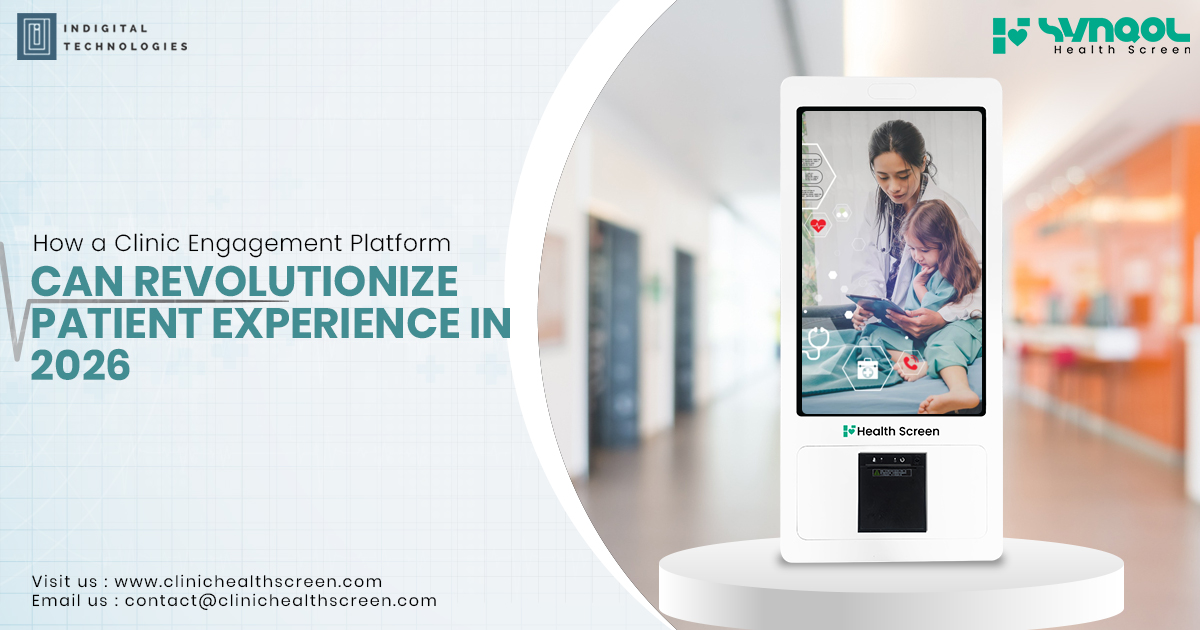
SynQOL Health Screen from Indigital Technologies is designed as a smart, in-clinic clinic engagement platform that brings together patient engagement, queue visibility, education, and screening support in one ecosystem.
What SynQOL Health Screen is built to do in a real OPD:
- Engage patients in waiting areas through structured content
- Improve perceived quality of care through organized patient flow
- Support doctors with patient education without consuming consultation time
- Offer an integrated patient engagement system for clinics that clinics can actually run daily
- Enable compliant pharma recall solutions through meaningful, education-first presence
If your goal in 2026 is smoother OPD management + better patient understanding + stronger clinic identity, SynQOL Health Screen is designed to operate exactly where these outcomes matter most: the waiting area.
How SynQOL Health Screen Improves Patient Experience (In Practical Terms)
A) Less Confusion, More Confidence
When token flow, content, and instructions are visible, patients feel guided rather than lost. This simple change improves:
- patient comfort
- staff control
- overall clinic atmosphere
B) Better Understanding Before the Consultation Starts
With scientific patient education tools playing in the waiting area, patients arrive in the consultation room:
- more prepared with relevant questions
- less influenced by misinformation
- more likely to understand lifestyle advice and follow-up plans
This leads to a smoother consultation flow for doctors.
C) A “Modern Clinic” Perception Without Expensive Renovation
One reason clinics and hospitals invest in engagement systems is perception. In 2026, patients associate:
- visible systems
- organized flow
- educational content
…with quality and professionalism.
SynQOL Health Screen supports that “modern OPD feel” in a functional way—not decorative.
Clinic Growth Strategies in 2026: Why Engagement Platforms Matter
Many clinics chase growth through marketing ads, listings, or discounts. But the biggest growth lever is still:
patient trust + repeat visits + word-of-mouth referrals
A clinic engagement platform strengthens exactly those drivers.
Clinic Growth Strategies enabled by better patient experience:
- More repeat visits because patients feel cared for
- Better referrals because the clinic appears organized and professional
- Higher acceptance of preventive screening because education is present
- Reduced receptionist overload and better throughput
- Stronger hospital OPD reputation because departments look managed
For hospitals, it also supports patient flow at scale—especially when multiple specialties run parallel OPDs.
SynQOL Health Screen supports these clinic growth strategies by improving what patients experience every single day.
Pharma Recall Solutions in 2026: Moving From Visibility to Meaningful Presence
Pharma brand managers face a tough reality:
- patients are overloaded with content
- compliance expectations are sharper
- doctors prefer patient-benefit tools, not just branding
- campaigns need measurable engagement outcomes
In 2026, the most sustainable pharma recall solutions are those that are:
- education-first
- clinic-friendly
- repeated exposure
- non-intrusive
- aligned with better patient outcomes
A clinic engagement platform creates this environment naturally.
How SynQOL Health Screen supports pharma recall solutions:
- Brand presence can be integrated with patient education formats (where appropriate)
- Repetition occurs daily with high footfall
- The brand is associated with “helpful learning,” not interruption
- The engagement happens during waiting time (not during consultation)
For brand managers, this is a rare combination: high-frequency recall + patient benefit + clinic acceptance.
Rural Health Education Tools: Why 2026 Needs a Different Approach
Rural and semi-urban settings often have:
- lower health literacy exposure
- limited specialist access
- high dependence on primary care clinics
- strong need for preventive education
Yet rural patients often receive fragmented information—posters that are outdated, or advice that is verbal and easily forgotten.
A clinic engagement platform can act as scalable rural health education tools by:
- standardizing education content
- using visual formats that cross language barriers
- reinforcing key preventive behaviors
- supporting primary physicians who manage diverse cases daily
SynQOL Health Screen can be positioned as a rural-ready engagement layer because it focuses on:
- simple, visual communication
- consistent in-clinic presence
- education that does not rely solely on doctor time
This makes it a strong fit for rural hospital OPDs and high-footfall PHC-style clinic environments where patient guidance is essential.
Patient Awareness Programs That Actually Work: The “Micro-Loop” Model
Most awareness fails because it is:
- too long
- too complex
- too occasional
- too disconnected from real-life action
In 2026, the winning format is a micro-loop:
- 20–60 second awareness content
- 3-step action checklists
- myth vs fact quick cards
- symptom red flags
- screening prompts
A clinic engagement platform can deliver these micro-loops repeatedly. That repetition is what turns awareness into action.
SynQOL Health Screen can host and rotate such patient awareness programs across therapy areas—making the waiting area a daily learning environment rather than an idle space.
For Doctors: What Changes When You Install a Clinic Engagement Platform?
Doctors don’t want extra tasks. They want smoother clinics.
A well-run patient engagement system for clinics supports doctors by:
- Reducing repeated basic questions (patients already saw the explanation)
- Making patients calmer and more cooperative
- Supporting preventive conversations (patients are primed)
- Improving waiting-area discipline
- Enhancing clinic identity (timings, expertise, services displayed clearly)
SynQOL Health Screen by Indigital Technologies is designed specifically around this doctor-first reality: improve patient experience without adding clinical burden.
For Hospitals: Why Engagement Platforms Are Becoming OPD Infrastructure
Hospitals in 2026 need operational systems that:
- handle high footfall
- reduce chaos
- improve satisfaction scores
- standardize communication across departments
A clinic engagement platform becomes a piece of OPD infrastructure, similar to:
- signage
- token systems
- helpdesk workflows
But better—because it is dynamic, educational, and repeatable.
SynQOL Health Screen fits into hospital OPDs as it can support:
- better flow visibility
- patient education loops
- improved waiting area experience
- stronger perception of “organized care”
For Pharma Brand Managers: Where the Real ROI Comes From
In 2026, ROI is not just “how many clinics installed.” ROI is:
- how consistently patients engage
- how aligned the system is with doctors
- how measurable the outputs are
- how compliant the communication feels
- how strongly the brand is recalled in a positive context
A clinic engagement platform is valuable to brand managers because it delivers:
- daily footfall exposure
- repeat message recall
- association with patient education
- clinic acceptance (less resistance than promotional-only assets)
That’s why SynQOL Health Screen is increasingly relevant as a modern, point-of-care pharma recall solution—because it is anchored in patient benefit.
Implementation Guide: How to Adopt a Clinic Engagement Platform Without Disrupting Workflow
Step 1: Map the Patient Journey (Waiting Area First)
Identify:
- where confusion happens
- where patients queue
- where they ask repeated questions
- where staff gets overloaded
Step 2: Decide the Core Outcomes
Choose 2–3 outcomes such as:
- queue clarity
- education delivery
- screening prompts
- clinic identity communication
Step 3: Design the Content Loop
Use:
- short explainers
- therapy-focused education
- seasonal tips
- awareness micro-loops
This is where scientific patient education tools matter—content should be simple, accurate, and clinic-safe.
Step 4: Select a Single Unified System
Avoid combining multiple disconnected tools.
A unified patient engagement system for clinics like SynQOL Health Screen from Indigital Technologies reduces complexity and ensures daily usability.
Step 5: Measure What Matters
Track:
- patient behavior changes (questions asked, awareness seen)
- staff workload reduction signals
- waiting-room order improvements
- consistency of education delivery
(Measurement methods can be simple and operational—no need for complex dashboards to start.)
Common Mistakes Clinics Make (and How to Avoid Them)
- Buying a TV and calling it engagement
A TV does not manage queues or deliver structured education. - Overloading with long content
In waiting areas, micro-content works best. - No therapy alignment
Patients pay attention when content matches what they are experiencing. - No operational owner
Assign a simple responsibility: “who ensures the system is running daily?” - One-time setup mindset
Engagement needs refresh cycles—weekly or monthly content updates.
SynQOL Health Screen is positioned to solve these operational gaps by being a clinic-native platform rather than a “content display.”
Use Cases in 2026 (Where SynQOL Health Screen Fits Best)
High-footfall specialty clinics
- diabetes, cardiology, respiratory, gastro, ortho, gynac
- where education improves adherence and follow-up clarity
Multi-doctor clinics
- where token visibility reduces confusion dramatically
Hospital OPDs
- where patient flow + education is a daily operational need
Rural or semi-urban clinics
- where rural health education tools must be visual and consistent
Pharma-supported awareness initiatives
- where patient awareness programs need repeated, compliant presence
FAQ (SEO-Optimized)
1) What is a clinic engagement platform?
A clinic engagement platform is a system used in clinic or hospital waiting areas to improve patient experience through queue visibility, education content, screening prompts, and structured communication that supports doctors and staff.
2) How is a patient engagement system for clinics different from a token machine?
A token machine mainly manages queue numbers. A patient engagement system for clinics combines queue clarity with scientific patient education tools, awareness content, and patient guidance—turning waiting time into useful learning time.
3) Why do pharma brand managers care about clinic engagement platforms?
Because they create high-frequency, point-of-care communication that functions as modern pharma recall solutions—education-first, clinic-accepted, and repeatable.
4) Can clinic engagement platforms work in rural settings?
Yes. In 2026, rural health education tools need visual and simple delivery. A clinic engagement platform helps standardize daily patient guidance without relying only on verbal counseling.
5) What is SynQOL Health Screen by Indigital Technologies?
SynQOL Health Screen from Indigital Technologies is a clinic-focused engagement platform that helps manage patient flow, deliver education content, support awareness, and enhance the waiting area experience for clinics and hospitals—while also enabling meaningful point-of-care engagement for pharma partners.
Final Takeaway: Patient Experience in 2026 Is Built Outside the Consultation Room
The biggest patient experience upgrades in 2026 are happening before the doctor even speaks.
A clinic engagement platform transforms the waiting area into a guided environment—where patients feel informed, calmer, and more prepared. For clinics and hospitals, this is operational improvement and brand perception in one. For pharma brand managers, it is the next evolution of pharma recall solutions: consistent, education-led presence that doctors accept because patients benefit.
If you’re looking to implement a unified patient engagement system for clinics with scientific patient education tools, scalable patient awareness programs, support for rural health education tools, and practical clinic growth strategies, then SynQOL Health Screen by Indigital Technologies is built to deliver that 2026-ready transformation—directly at the point of care.